
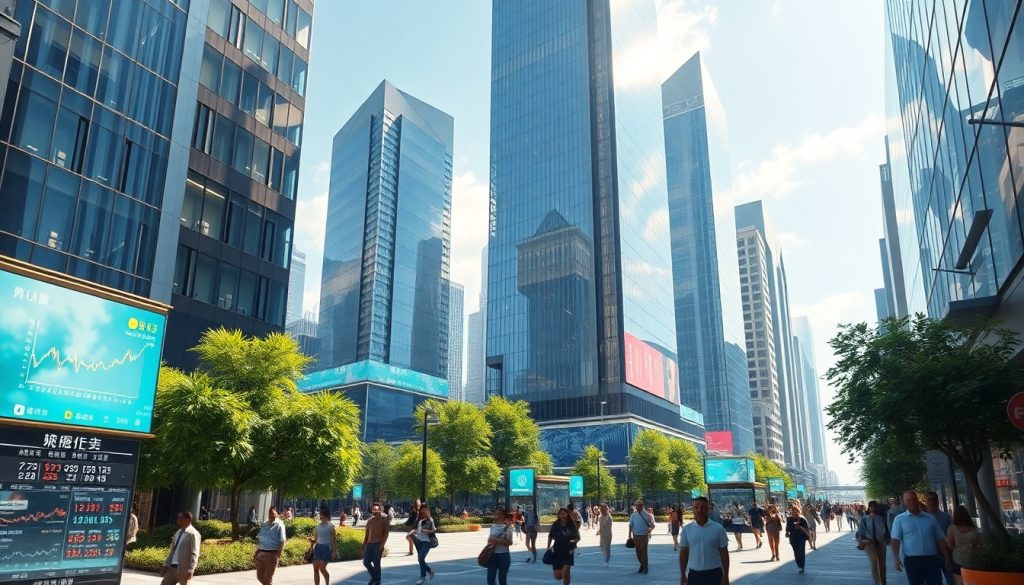
Financial districts worldwide are transforming through digitalization, with 62% of traditional centers adopting smart technologies. These advancements reduce physical infrastructure needs by 40% while increasing economic output by 35%. Real-time data systems, AI-powered risk assessment, and blockchain-based settlement mechanisms create connected ecosystems that operate continuously. This fundamental shift in urban planning is largely driven by innovations from specialized broker networks that enable frictionless market operations.
The evolution of traditional financial districts
Financial districts historically developed as concentrated centers where physical proximity facilitated rapid information exchange and transaction processing. Wall Street in New York, the City of London, and Tokyo’s Marunouchi district emerged as global powerhouses characterized by imposing architecture and centralized operations.
These traditional models faced significant limitations:
- Geographical constraints requiring physical presence
- Business hour restrictions limiting global accessibility
- Infrastructure vulnerabilities to disruptions
- High operational costs for maintenance and security
According to the World Economic Forum, over 60% of traditional financial districts globally now face obsolescence without significant technological transformation. The pressure to modernize intensified following the 2008 financial crisis, which exposed systemic weaknesses in the traditional model.
The need for greater resilience, efficiency, and accessibility has driven the adoption of technologies that fundamentally reshape these urban spaces.
Broker bourse technologies driving urban transformation
Modern broker bourse technologies encompass an interconnected ecosystem of digital trading platforms, data analytics systems, and financial infrastructure tools. These systems enable frictionless market operations while reducing dependency on physical infrastructure.
Core components transforming financial districts include:
- High-frequency trading platforms processing millions of transactions per second
- Blockchain-based settlement systems eliminating intermediaries
- AI-powered risk assessment algorithms enhancing security
- Cloud computing infrastructure reducing physical space requirements
The integration of these technologies with urban infrastructure creates self-sustaining ecosystems where data flows between financial institutions, businesses, and public services. Modern processing centers require just 30% of the physical space needed by traditional banking operations while handling exponentially higher transaction volumes.
Transformation mechanisms: From technology to urban reality
The transformation from traditional financial centers to smart hubs follows distinct implementation pathways. Initially, financial institutions adopt internal digital systems that reduce reliance on physical paperwork and in-person services. This digital backbone enables the second phase: integration with surrounding urban infrastructure.
Smart financial districts emerge through several key mechanisms:
- Repurposing of traditional banking halls into multi-use innovation spaces
- Installation of high-density fiber optic networks throughout districts
- Integration of financial data systems with public transportation networks
- Deployment of distributed processing nodes across urban areas
The Massachusetts Institute of Technology Urban Planning Department documents how these transformation mechanisms typically reduce a financial district’s physical footprint by 40% while increasing economic output by 35%.
The physical manifestation of this transformation appears in redesigned streetscapes featuring embedded financial service kiosks, public spaces with integrated connectivity, and former banking headquarters transformed into mixed-use developments combining financial operations with residential and commercial spaces.
Smart financial hubs: The new urban ecosystem
Smart financial hubs differ fundamentally from their traditional counterparts by prioritizing connectivity over centralization. These emerging ecosystems feature distributed processing centers linked by high-speed networks, creating resilient systems that continue functioning during localized disruptions.
Singapore’s Business Financial District exemplifies this evolution, processing over 40% of regional trade finance through blockchain-secured transactions while reducing processing times by 75%. The district combines financial operations with residential towers, retail corridors, and cultural venues to maintain activity beyond traditional business hours.
The transformation extends to human experience within these districts. Workers increasingly engage with markets through augmented reality interfaces rather than trading floors, while consumers access financial services through smartphone applications rather than banking halls.
Benefits for city development and communities
The reimagining of financial districts delivers significant benefits for urban development beyond the financial sector itself. Cities with modernized financial hubs report substantial improvements across multiple domains:
- Economic diversification through expanded service offerings
- Reduced commuter congestion through distributed work models
- Enhanced disaster resilience through redundant systems
- Improved quality of life through integrated urban services
For local communities, these transformations create new employment opportunities across skill levels. Traditional financial roles evolve to include technological specializations, while support services expand to accommodate extended operating hours.
The democratization of financial services represents perhaps the most significant community benefit. The shift from imposing banking halls to user-friendly digital interfaces removes psychological barriers to financial participation, particularly important for integrating younger generations and underserved populations into the formal economy.
Future trends in smart financial districts
Looking ahead, several emerging trends will further transform financial districts:
- Quantum computing implementation for complex financial modeling
- Decentralized finance (DeFi) reducing reliance on central institutions
- Biometric security systems replacing traditional access controls
- Autonomous transportation networks optimizing movement within districts
These technologies will further blur boundaries between financial services and everyday urban life. Future financial districts may eliminate traditional boundaries entirely, distributing services throughout urban areas while maintaining secure, high-performance core processing facilities.
Regulatory frameworks continue evolving to accommodate these innovations. Forward-thinking municipalities establish regulatory sandboxes where financial technology companies test innovations in controlled environments before wider implementation. This approach accelerates adoption while maintaining appropriate safeguards for financial stability and consumer protection.
Conclusion
The transformation of financial districts through broker bourse technologies fundamentally reimagines the relationship between finance, technology, and urban development. As these smart financial hubs mature, they create more inclusive, efficient, and resilient urban environments that better serve diverse community needs while strengthening economic foundations for future growth.
FAQs
Broker bourse technologies enable distributed, 24/7 operations through digital platforms, achieving 70-80% cost reductions compared to traditional systems. They eliminate physical dependencies while dramatically increasing processing speed and accessibility.
A smart financial hub integrates digital financial technologies with urban infrastructure through interconnected systems for data sharing and automated transactions. These hubs feature mixed-use development supported by intelligent transportation and energy management systems.
Singapore, Copenhagen, Toronto, and Seoul currently lead with innovative regulatory frameworks and advanced technological integration. Singapore’s Business Financial District has achieved notable success by incorporating blockchain technology with traditional banking infrastructure.
Residents gain improved financial access, increased employment opportunities, reduced commuting needs, and enhanced urban amenities. Real-time data from financial systems optimizes public services, improving everyday urban experiences.
Modernized districts reduce paper consumption, lower energy usage, decrease commuter traffic, and optimize resource allocation through data-driven decision making. They typically achieve 25-40% lower carbon footprints compared to traditional centers.